If you have ever looked at two Lake Austin properties in Tarrytown and wondered why the price gap is so wide, you are not alone. Waterfront value here is rarely about one simple number, and it definitely is not explained by the broader Austin market. On Lake Austin, buyers are paying for a very specific mix of shoreline, access, entitlement, and home quality. If you want to understand what really moves value in this micro-market, let’s dive in.
Why Lake Austin value works differently
Lake Austin is not priced like a typical Austin home search. It is a pass-through reservoir that is maintained at a relatively constant water level, and public reporting showed the lake at 492.13 feet on June 13, 2026, almost exactly in line with its monthly average of 492.21 feet. That consistency means pricing in Tarrytown is driven more by the property itself than by seasonal water-level swings.
That matters because buyers are not simply shopping for an Austin address. They are often shopping for a particular stretch of shoreline, a certain type of water access, and a close-in Tarrytown setting that public listings regularly describe as rare. In other words, Lake Austin waterfront valuation is a micro-market exercise, not a median-price exercise.
Tarrytown location carries its own premium
Within the Lake Austin corridor, Tarrytown stands apart because it offers close-in access with a limited supply of waterfront opportunities. Public listings describe parts of this area as the center or heart of Tarrytown and as a rare waterfront pocket. That helps explain why buyers often pay a premium for lake access this close to central Austin.
But even within Tarrytown, not every waterfront property is valued the same way. A protected stretch of water, a view orientation, privacy, and how the home sits on the lot can all change buyer perception. In practice, the market often rewards the exact shoreline segment as much as the neighborhood name.
Shoreline footage matters, but usable frontage matters more
It is easy to assume that more shoreline always means more value. In reality, frontage is important, but the market responds most strongly to usable frontage. Recent public examples on Lake Austin have highlighted everything from about 80 feet of waterfront access to 175 feet at a recent sale, 260 feet at a waterfront estate, and even 445 feet at another high-end listing.
Those properties were not priced the same, because frontage by itself does not tell the whole story. The lot shape, the privacy level, and the potential to improve or enjoy that shoreline can all affect value. A long but awkward shoreline may not compete the same way as a shorter stretch that is more functional and more private.
Slope and topography can change the buyer experience
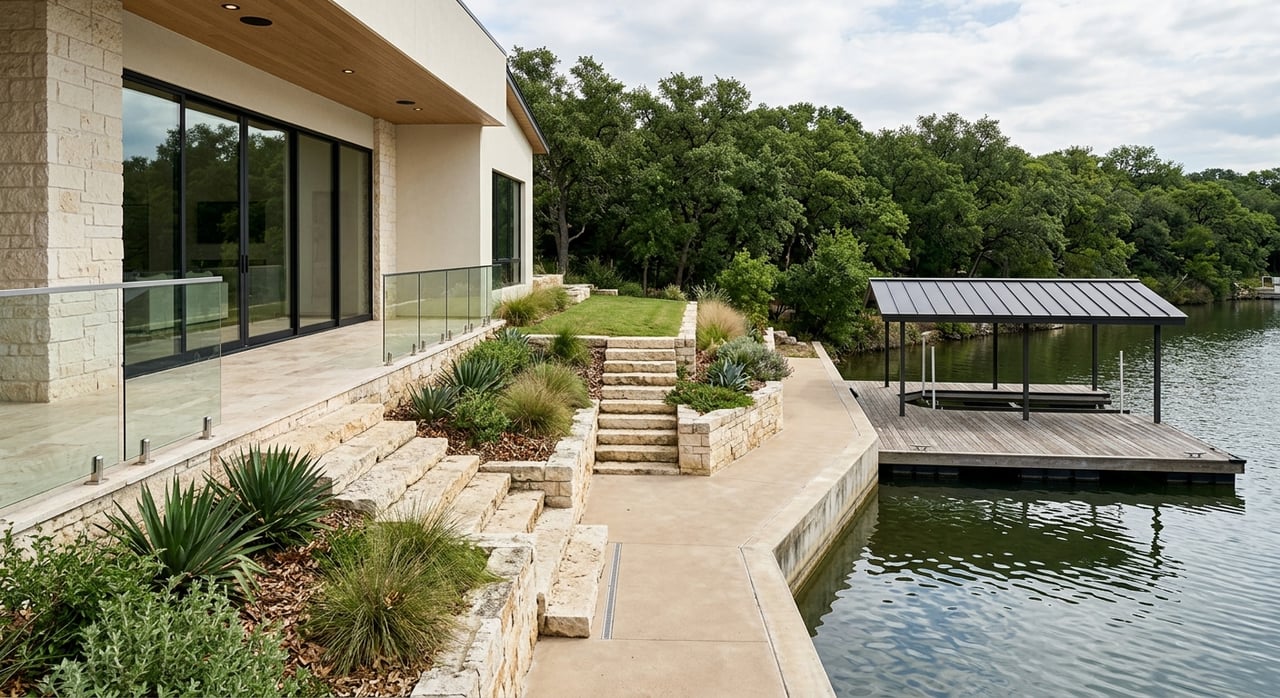
One of the biggest value drivers on Lake Austin is how easily you can actually reach the water. A gently sloped lawn often feels very different from a steep site that requires stairs, a tram, or a longer path. Buyers notice that difference immediately because it affects day-to-day enjoyment.
Public Lake Austin listings show just how varied this can be. Some describe a gently sloped lawn with a lit path to the water, while others highlight tram access or a dock located below a pool terrace. Two homes can both be on the lake, but if one offers an easier and more seamless connection to the shoreline, it may command stronger interest.
Water access type is a major pricing factor
This is one of the clearest distinctions in the Tarrytown waterfront market. A property with true private shoreline and a private dock does not trade like a property with shared or slip-based access. Even when both options offer boating convenience, buyers usually see them as very different lifestyle products.
Public data in Tarrytown makes that clear. A condo at 1500 Scenic sold for $1.749 million with a dedicated boat slip, which is meaningful value. But that kind of access does not price the same way as a single-family waterfront home with a larger lot, private dock, and stronger indoor-outdoor living setup.
Dock status can create a real value gap
On Lake Austin, dock entitlement and compliance matter more than many buyers first expect. According to Austin Development Services, construction on or next to the water may require specific reviews and permits, and the city requires boat-dock registration after construction. City code also limits dock placement and size, including setbacks from side property lines and footprint standards tied to shoreline width.
That is why two lots that seem similar on first glance may carry very different values. If one property already has a private dock, boat lifts, or a compliant oversized dock program, it may be far more appealing than a lot where future dock potential is uncertain. Existing dock status reduces questions, and in a luxury waterfront purchase, fewer unknowns often support stronger pricing.
The home itself can reset the entire value story
Waterfront buyers are not buying land alone. They are buying the site and the home as one package, and the quality of that package can dramatically affect value. Architectural style, renovation level, finish quality, and how the house connects to the outdoors all influence what buyers are willing to pay.
A strong example is 2908 Scenic in Tarrytown, which had a prior public sale at $2.995 million and is now marketed at $8.5 million after a comprehensive renovation. That kind of jump is a reminder that a transformed home can completely reshape the pricing conversation. By comparison, a 2024-built Lake Austin home at 2403 Big Horn is offered at $3.745 million with an oversized dock, while 2304 Island Wood sold for $5.85 million with over an acre and a half of lawn and a covered dock.
Why broad Austin averages do not help much
Broader market data can offer background, but it should not drive your conclusion on Tarrytown waterfront value. Unlock MLS reported renewed spring activity in 2026, and the May 2026 report showed a $390,000 median residential price for the Austin-Round Rock-San Marcos MSA and a $535,000 median for Travis County. Those numbers sit far below Lake Austin waterfront pricing.
That gap is exactly why general Austin price trends can be misleading in this niche. A waterfront property in Tarrytown lives in its own lane, shaped by scarcity, entitlement, and lifestyle factors that the broader market does not capture. If you want a realistic value opinion, the best comparisons usually come from the same lake, the same shoreline segment, and a similar access type.
Recent public examples show the spread
Recent public examples show just how wide the value range can be. On one end, there was the $1.749 million Tarrytown condo with a dedicated boat slip. On the higher end, public examples include a waterfront estate around $6.995 million with about 175 feet of frontage and a current Tarrytown waterfront listing at $8.5 million.
There is another useful lesson in the upper end of the market. A high-end Lake Austin listing with 445 feet of waterfront and a two-slip dock also showed a price reduction and a long time on market. That suggests exceptional shoreline still needs the right pricing strategy, the right home, and the right dock program to meet the market.
Questions that really affect Lake Austin value
If you are buying or selling in Tarrytown, these are some of the most important questions to ask:
- How much shoreline is actually usable?
- Is the water access private, shared, or slip-based?
- Does the site support a legal and appropriately sized dock?
- Is access to the shoreline easy, or does it require stairs, a tram, or a steep drop?
- How does the lot’s shape, privacy, and orientation affect enjoyment?
- Does the home quality support the price the site is trying to command?
- Does the property fall inside the City of Austin’s Lake Austin frontage jurisdiction for septic and remodeling work?
These questions often have a bigger impact on value than buyers expect. They also explain why surface-level comparisons can lead to the wrong conclusion.
What buyers and sellers should take away
For buyers, the key is to look past the label of “waterfront” and study what the property truly delivers. Not all shoreline is equal, and not all access creates the same experience or resale strength. A careful review of frontage, slope, dock status, and home quality can help you avoid overpaying for a property that looks stronger on paper than it feels in person.
For sellers, the lesson is just as important. The best pricing strategy usually comes from identifying what makes your property specifically valuable, then comparing it against properties with a truly similar shoreline segment and access profile. In a market this specialized, broad averages and loose comps can leave money on the table or slow down your sale.
When you are evaluating a Lake Austin property in Tarrytown, the real question is not just whether it is on the water. The real question is how well that site, access, entitlement, and home come together. If you want a discreet, informed perspective on buying or selling along Lake Austin, connect with Megan DiBartolo.
FAQs
How is Lake Austin waterfront value determined in Tarrytown?
- Lake Austin waterfront value in Tarrytown is usually shaped by the combination of usable shoreline, slope, location along the lake, dock status, access type, and the quality of the home itself.
Does more shoreline always mean a higher Lake Austin price?
- No. More frontage can help, but the market often pays more for shoreline that is private, functional, and easy to enjoy than for frontage that is longer but less usable.
Why does dock status matter for Lake Austin homes?
- Dock status matters because City of Austin rules affect dock placement, size, and registration, so an existing compliant dock or established dock program can make a property more valuable than a similar lot with uncertain dock potential.
Are Tarrytown boat-slip properties valued like private waterfront homes?
- No. A dedicated boat slip can add meaningful value, but it does not usually price the same way as a single-family property with true private shoreline and a private dock.
Should you use general Austin market data to price a Lake Austin property?
- Usually no. General Austin and Travis County medians are far below Lake Austin waterfront levels, so pricing is best based on comparable sales from the same lake, shoreline segment, and access type.